
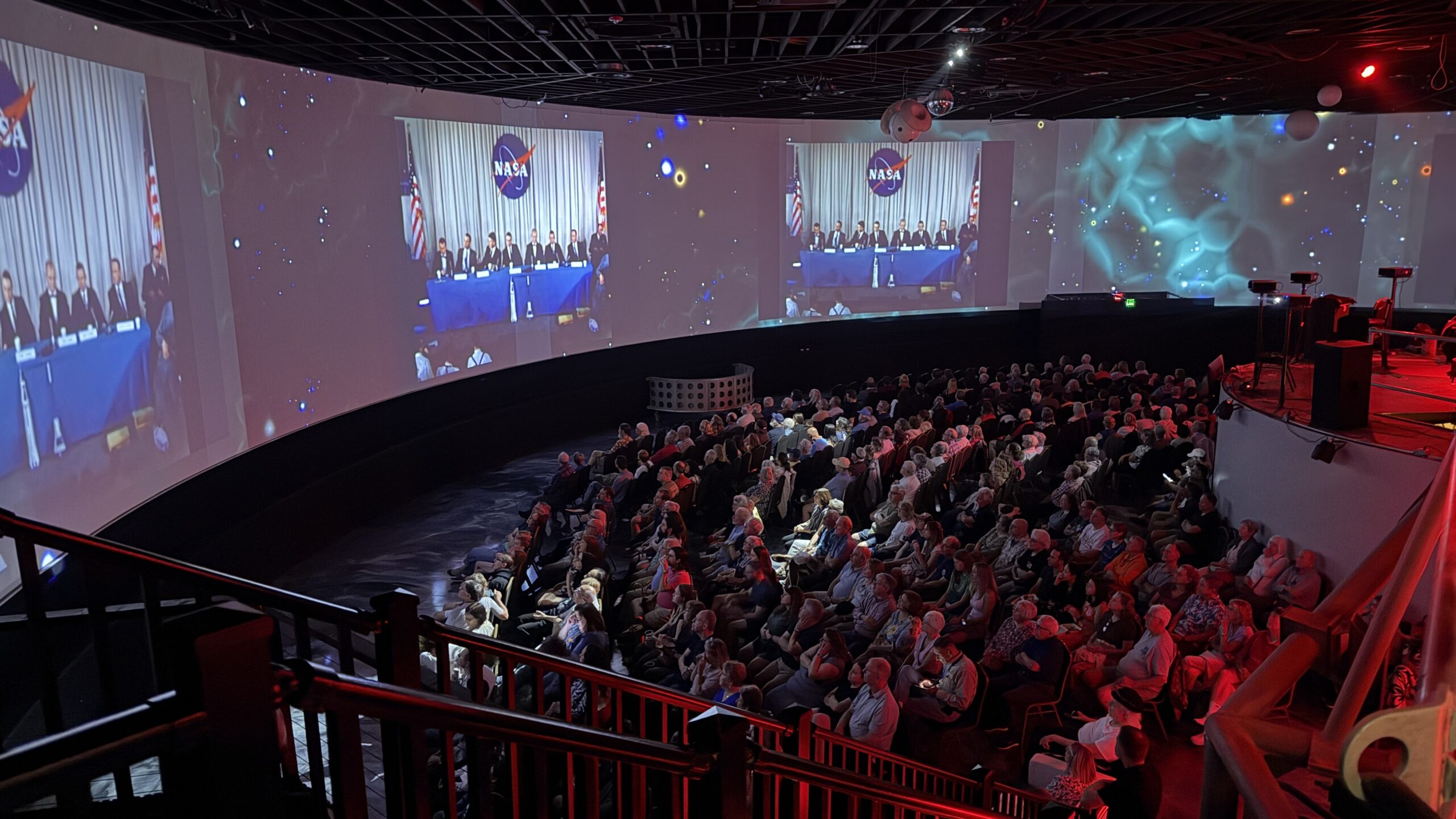
Some moments stay with you long after they’re over. The first official private screening of Before the Moon at The Fuge (Johnsville Centrifuge) was one of those moments.
More than 850 people filled the former Naval Air Development Center building for a sold-out evening celebrating a story that, for decades, had quietly existed in the memories of the people who lived it. Families, former NADC employees, historians, engineers, astronauts, veterans, and members of the local community all gathered inside the same building where generations of military aviators and NASA astronauts once trained to withstand the forces of flight.

As guests arrived, there was an energy throughout the building that was difficult to describe. Everywhere you looked, people were wearing Before the Moon shirts, reconnecting with old friends, introducing themselves to former coworkers, and sharing stories about their time at Johnsville. Many of our VIP guests received a copy of the Before the Moon companion book, and it was rewarding to watch them flipping through its pages while waiting for the lights to dim. Some immediately recognized familiar faces in the photographs. Others paused on archival images they hadn’t seen in decades.
For a filmmaker, those moments are incredibly meaningful. After spending years researching, conducting interviews, searching archives, and editing the documentary, it was the first opportunity to see so many of the people who helped shape the story experience it together.
The audience itself reflected the remarkable reach of the film.

NASA astronaut Chris Ferguson joined us for the evening, along with NASA spacesuit engineer Dr. Louis Carfagno, whose work continues the tradition of innovation explored throughout the documentary. Also in attendance were Kirsten Armstrong, former Rockwell Space Shuttle analyst, Eleanor O’Rangers of the Southeastern Pennsylvania Cold War Historical Society, numerous former Naval Air Development Center employees, historians, researchers, and many of the individuals whose interviews appear throughout the film. Watching them greet one another before the screening felt like watching the documentary come to life.
When the lights finally went down and the film began, the room grew remarkably quiet.
One of the goals of Before the Moon has always been to tell a larger story about American innovation. Rather than beginning with Apollo, the film traces a much longer path through Bucks County’s history—from early inventors and transportation pioneers to aviation research, the Naval Air Development Center, the Johnsville Centrifuge, and ultimately NASA’s journey to the Moon. Seeing an audience experience those connections together was one of the most rewarding parts of the evening.

After the screening, guests stayed to talk, share memories, and reflect on what they had seen. Many commented that they had lived in the area for years without realizing the extraordinary role Warminster played in America’s aerospace history.
One guest remarked,
“I was blown away as to how much Bucks County played a role in the Space Race and training of the astronauts.”
Another shared,
“I couldn’t believe the fact that America’s most famous astronauts trained here in our state and our town.”
Several people spoke about how much they appreciated learning the science behind astronaut training. One attendee mentioned that understanding how centrifuge acceleration training improved astronauts’ ability to maintain blood flow during spaceflight gave them an entirely new appreciation for the preparation that happened long before launch day.
Others were drawn to the broader historical story.
One viewer commented,
“I was really interested in the history of planes, and how it kept slowly building up to the age of space exploration. Really wonderful storytelling.”
Another highlighted the film’s exploration of local industry, saying,
“The portions that focused on the history of industry in Warminster and the importance of the NADC in flight and space programs were just incredible.”
Many audience members also noticed the care that went into the production itself. One guest praised the way archival footage, interviews, narration, and historical audio were woven together, describing the presentation as dynamic and engaging. Another complimented the musical score and the film’s overall structure, saying it balanced factual storytelling with an entertaining pace.
Several people also mentioned something that had been especially important throughout the production: recognizing the many people whose contributions are often overlooked. One audience member appreciated that the documentary acknowledged pioneers beyond the astronauts themselves, including the “Mercury 7½,” women scientists, engineers, technicians, and the diverse group of people whose work made human spaceflight possible.

That observation captured one of the central ideas behind Before the Moon. The journey to the Moon was built by thousands of individuals whose names rarely appear in history books. Their work happened in laboratories, machine shops, wind tunnels, classrooms, and testing facilities like Johnsville. This film exists because their stories deserve to be remembered alongside the missions they helped make possible.
The evening was also deeply personal.
Many former NADC employees attended with their children and grandchildren. Throughout the reception, conversations unfolded between generations as families pointed to photographs, recognized coworkers in archival footage, and shared memories that might otherwise have been lost with time. Those conversations reminded me that documentaries do more than preserve history. They create opportunities for people to reconnect with it together.
As the evening came to a close, there was a strong sense that this was only the beginning of the film’s journey.

With more than twenty film festivals currently reviewing Before the Moon and additional public screenings already being planned, the documentary will continue reaching new audiences over the coming months. Every screening offers another opportunity to introduce people to the remarkable story of the Johnsville Centrifuge, the Naval Air Development Center, and the generations of innovators whose work quietly helped prepare humanity for space.
To everyone who attended the premiere, volunteered, supported the project, participated in interviews, shared photographs, preserved history, or simply came to experience the film, thank you.
After years of research and production, seeing over 850 people gathered inside the Johnsville Centrifuge to celebrate this history was something I’ll never forget. It was an evening that honored the past, celebrated the people who lived it, and reminded all of us that some of history’s most important stories begin much closer to home than we ever realize.
Leave a Reply