

What If I Told You the Space Race Started on a River?
One summer afternoon in 1787, as America’s founders debated the Constitution in Philadelphia, a ragged inventor stood on the banks of the Delaware River, staring at a contraption unlike anything the world had seen. It hissed, clanked, and belched steam. Then—it moved.
John Fitch’s steamboat lurched forward against the current. Not with sails. Not with oars. With fire and water.
That moment changed everything. But we forgot it.
Who Was John Fitch—and Why Should We Care?
If you’ve heard of Robert Fulton, you’re not alone. He’s the man credited with inventing the steamboat. But he wasn’t the first. That title belongs to John Fitch, a war-scarred, self-taught mechanic from Bucks County, Pennsylvania—just upriver from the site that would later become a Cold War centrifuge training America’s first astronauts.
Fitch’s 1787 steamboat trial proved that steam propulsion wasn’t just possible—it was powerful. His boat carried delegates, Congressmen, and onlookers several miles against the river’s current, making it the first successful demonstration of steam-powered transportation in the United States.
So why didn’t he become a household name?
-
Patent wars: Fitch fought bitterly for protection, only to lose ground to rivals like Fulton.
-
Financial ruin: Investors were wary. He died penniless and heartbroken.
-
History’s blind spot: Like many pioneers, Fitch was buried beneath louder, richer, and better-connected successors.
Yet his story still echoes in every engine, every rocket, every launch that defies gravity.
“He had the spirit of Watt, but not the marketplace of London.” — David Thomas, Curator at the John Fitch Steamboat Museum
Source: Science History Institute
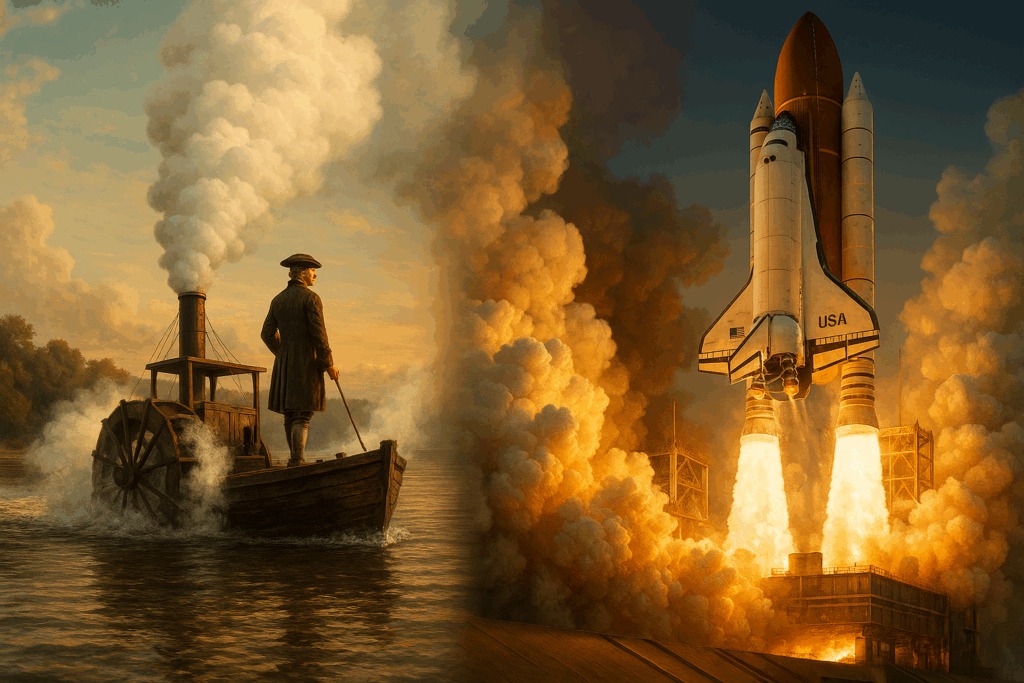
The Link Between Steam and Space
Here’s where it gets wild: NASA’s rockets and Fitch’s steamboat run on the same core principle—turning thermal energy into propulsion.
Let that sink in.
When hydrogen and oxygen combust in a Space Shuttle main engine, they produce superheated steam. That exhaust exits through a nozzle, thrusting the rocket skyward—just as Fitch’s paddle wheels drove his boat upstream.
Both machines, centuries apart, harness heat and pressure to move humanity forward.
Key Takeaways
-
John Fitch launched the first successful steamboat in 1787—decades before Fulton.
-
His invention proved that mechanical propulsion was possible long before the industrial age.
-
Fitch’s legacy foreshadows the physics behind modern rocketry and spaceflight.
-
His story embodies the cost of being ahead of your time—ignored, broke, and brilliant.
-
Innovation isn’t just about machines. It’s about daring to try when the world says no.
From Riverboats to Rockets: Why This Matters
In researching Before The Moon, our documentary on Warminster’s role in space history, we kept tracing the story further and further back—until we landed on Fitch. And once we did, the through-line became impossible to ignore: American innovation has always started in the quiet corners—on riverbanks, in barns, in old navy hangars.
And that legacy? It belongs to all of us.
Ready to Rediscover America’s First Inventor?
Leave a comment if you’d ever heard of John Fitch—or if you want to visit the site of his 1787 trial (hint: it’s still there). Share this post with a fellow history buff or space geek. And subscribe for more untold stories that connect our past to the stars.
👉 Learn more about our film at BeforeTheMoonFilm.com
Leave a Reply